
IN ENGLISH
PYLKÖNMÄKI – Naturally Wild and Beautiful
Pylkönmäki is an idyllic rural community in Central Finland with a strong tradition of cooperation and helping one’s neighbours.
In the former days in the neighbouring area of Saarijärvi there was a saying “to be abroad in Pylkönmäki” – travelling to Pylkönmäki felt as long as going abroad because of the poor road conditions and high hills. Nowadays the trip from Saarijärvi to Pylkönmäki by car takes only about 30 minutes.
Pylkönmäki was an independent rural municipality from 1914 until 2009, when it joined the small town of Saarijärvi. Now the five small villages of the former Pylkönmäki municipality have formed a common Pylkönmäki Village Association called “Pylkön Ääni” – The Voice of Pylkönmäki.
Inhabitants in Pylkönmäki
The area of Pylkönmäki has 848 inhabitants (2011) and about 60 small companies. On top of that there are about 400 holiday homes which means that the population more or less triples in summer holiday months. The vacation residents bring new skills and networks to the community.
Pylkönmäki is situated in the border area – the people in Pylkönmäki speak three different dialects depending on the corner of the area where they are living.
Pylkönmäki is an active village. It is known for the amateur theater group of the “Pääjärven Nuorisoseura” Association, and for the sports club “Pylkönmäen Yrittävä”, founded in 1912. The sports club organises a big skiing competition every winter, “Pylkönhiihto” and a children’s olympics event “Pentin olympialaiset” each summer. The skiing event is one of the few in Finland with a 50-kilometer race, and the olympics have become well-known because every child who participates receives a medal.
“Pääjärven Nuorisoseura” Association and the sports club “Pylkönmäen Yrittävä” jointly own the Yrittävän talo Village Hall which can be rented very affordably to host occasions for up to 150 people.
Services in Pylkönmäki
For a visitor Pylkönmäki offers a small grocery shop SALE; The Evästupa Café and Grill with lunch, catering service, Matkahuolto Parcel Service and DVD rental, a small library, postal service, free Internet and books, newspapers and magazines to read; a pharmacy, and a health centre. The village also offers theatre, music and sports events.
For the residents there is a kindergarden, an elementary school, care of the elderly, an active congregation, and a service point of public services at the library.
The basic services are good. However, Pylkönmäki lost its petrol station a few years back. Although the villagers have tried to get the station reopened, they have not succeeded. It is advised to fill the tank either in Saarijärvi or in Ähtäri. The Evästupa café & grill by the library keeps a small amount of emergency petrol (98), tel. +358 (0)40 1840227, open every day.
Nature of Pylkönmäki
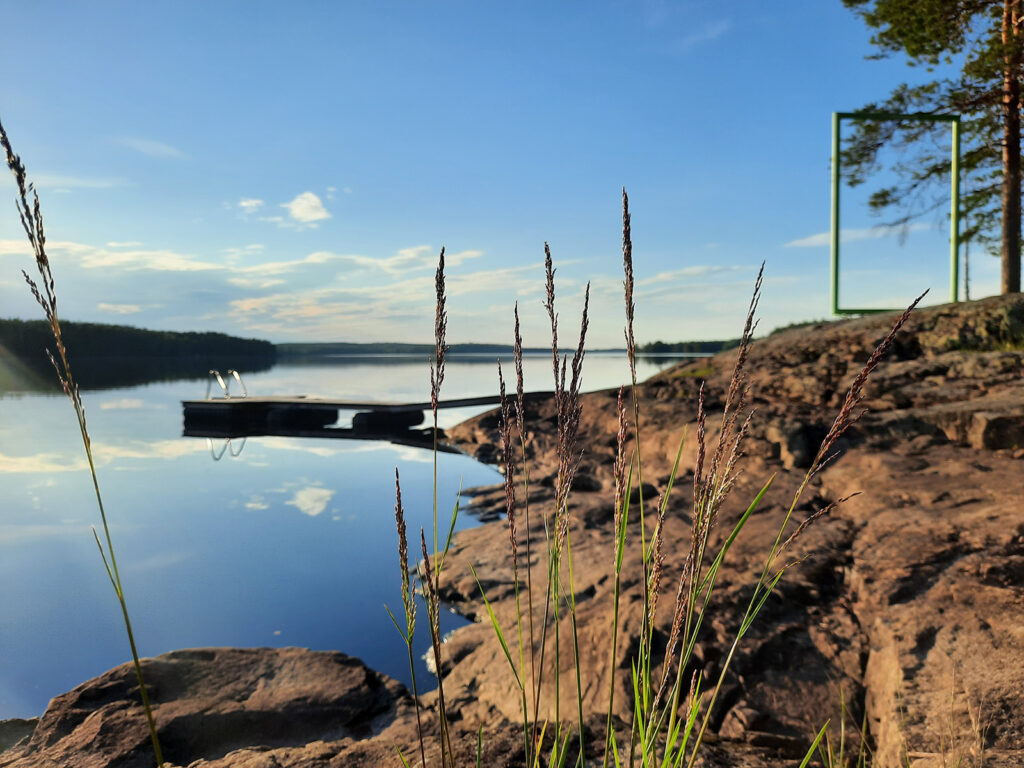
The hilly forest scenery of Pylkönmäki is coloured by about 60 lakes and ponds surrounded by farmhouses and pastures. The wild nature is always near you as wolves, bears, lynxes and other wild animals roam in the neighbouring forests. Especially fishermen are enthusiastic about the area due to the many rapids full of fish.
For a quick look, some of the best scenery of the area can be seen by driving around the Lake Karanka.
Architecture of Pylkönmäki
There are several regionally important building sites in Pylkönmäki.
The road of Mulikka-Laatokka shows typical local architecture and sceneries. The route starts from the small River Karajoki with the mill to the Kouheroisensalmi bridge of Lake Pääjärvi. Along the route there are six small farms built during 1900-1920 for poor people and small farmers and a small chapel. At the north end of the area one can see that the Hokkala farm, standing strategically on the highest hill, was a prominent factor in the village. The scenic tour ends at the Kouheroisensalmi bridge built in 1911.
The Church
The simple but beautiful wooden Church of Pylkönmäki was planned by a famous church builder Jaakko Kuorikoski in 1860. The building was done as much as possible by local work and donations. The wooden pulpit and the wooden ’poor-house man,’ both sculpted by a local farmer Taavetti Pajunen, are original. The poor-house man stands in the entryway of the church and was used as a depository for monetary offerings for the needy.
The original architecture was changed in 1926-1927 by a 28 year-old architecture student, Alvar Aalto, who later became world famous for his pure Nordic style. He redesigned many features of the church: the sharp tower was cut shorter, the outer walls were changed, the tall windows were cut into two, and a round entryway was added on the side. The villagers disliked many of the outer changes but loved the changes inside the church (the best of the changes was the heating!). The latest remodeling dates from 1967-1968 when architects Erkki Kantonen and Niilo Hartikainen planned new panelling, new benches, and a new dropped ceiling which has imbedded light fixtures. The church’s first pipe organ, which is located in the organ loft, was built by the Kangasala Organ Company in 1952. In 1989 the Tuomi Organ Company built a new organ next to the altar. The church can seat about 300 people. Church services are held about three times a month on Sunday at 1:00 pm.
The Parsonage
The old parsonage by the church was built in 1907. It used to be one of the central buildings in the village, but for the past few years it has been a private home.
The Parish Hall
When the parish was built in 1971, it had a small indoor swimming pool and sauna. During the first twenty years it was in active use by not only the local parishoners, but also by people from Saarijärvi and Karstula. When Saarijärvi built a bigger swimming facility, the pool in Pylkönmäki was converted into a parish office. The Parish of Pylkönmäki joined the the Parish of Saarijärvi in 2007.
Tourism
ylkönmäki is naturally wild and beautiful. The villages are surrounded by rivers and rapids, lakes and ponds. Fishing www.fishing.fi and canoeing https://www.saarijarviregion.fi/activities/excursions_on_water are among the most popular hobbies in the area!
Canoe rental https://www.saarijarvenlatu.fi/valinevuokrausta.html
There are several possibilities for accommodation in Pylkönmäki, please see https://www.pylkonmaki.fi/yritykset-ja-palvelut/matkailuyritykset/.
Jakola Farm www.jakola.fi is located in the village of Pääjärvi. In addition to cosy accommodation their special feature is one of Finland’s largest private car museums. All cars can be rented!
Perfect day trips can be made to Saarijärvi and to Ähtäri. In Ähtäri the Ähtäri Zoo www.ahtarinelainpuisto.fi presents Finnish wild life. In Saarijärvi there are plenty to see www.saarijarviregion.fi – try e.g. the Stone Age Village, a reconstruction of a late Stone Age village based on archaeological research. En route to Saarijärvi, one can stop in Mahlu village to admire the triptych “Maapallopatsas” (Globe Monument) built in 1950-55 in divine inspiration by the local gunsmith Matti Rutanen. He had a vision of God who told him to build a monument for all the people on earth – for the living, the dead, and the unborn. The statue is considered to be one of the most important naivistic works of art in Finland. (And, by the way, there is a geocache at the statue)
For nature lovers the best targets are the two national parks, Pyhä-Häkki and Salamajärvi, see photos. Pyhä-Häkki contains some of the most pristine old-growth forests and peatland in Finland. Walk the 3 or 6 km long trail among the 500 year old pines in summer or take snow-shoes or skis with you in winter. In summer season an English-speaking guide is available. Other recommendable nature trips can be made to Kulhanvuori and Julmatlammet, see https://www.saarijarviregion.fi/activities/hiking_areas
Distances
Pylkönmäki – Saarijärvi 33km, 30min
Ähtäri 45km, 45min
Pyhä-Häkki National Park 55km
Nearest airport in Tikkakoski, Jyväskylä 80km, 1 hour